Preliminary Mission Design Tool (PMDT) for multi-target ADR tours
Overview
PMDT is a preliminary mission design tool built to evaluate and optimise multi-target low-thrust active debris removal (ADR) tours with realistic operational effects: \(J_2\)-induced precession for RAAN matching, atmospheric drag, eclipses (available thrust time), and duty cycles.
- • Per-leg \(\Delta v\) and time-of-flight (TOF) estimates for a candidate tour
- • A RAAN-matching transfer construction using a thrust–phasing–thrust sequence
- • Support for drag, eclipses, and duty-cycle constraints in the low-thrust transfer model
- • A practical basis for screening many tour candidates before committing to high-fidelity optimisation
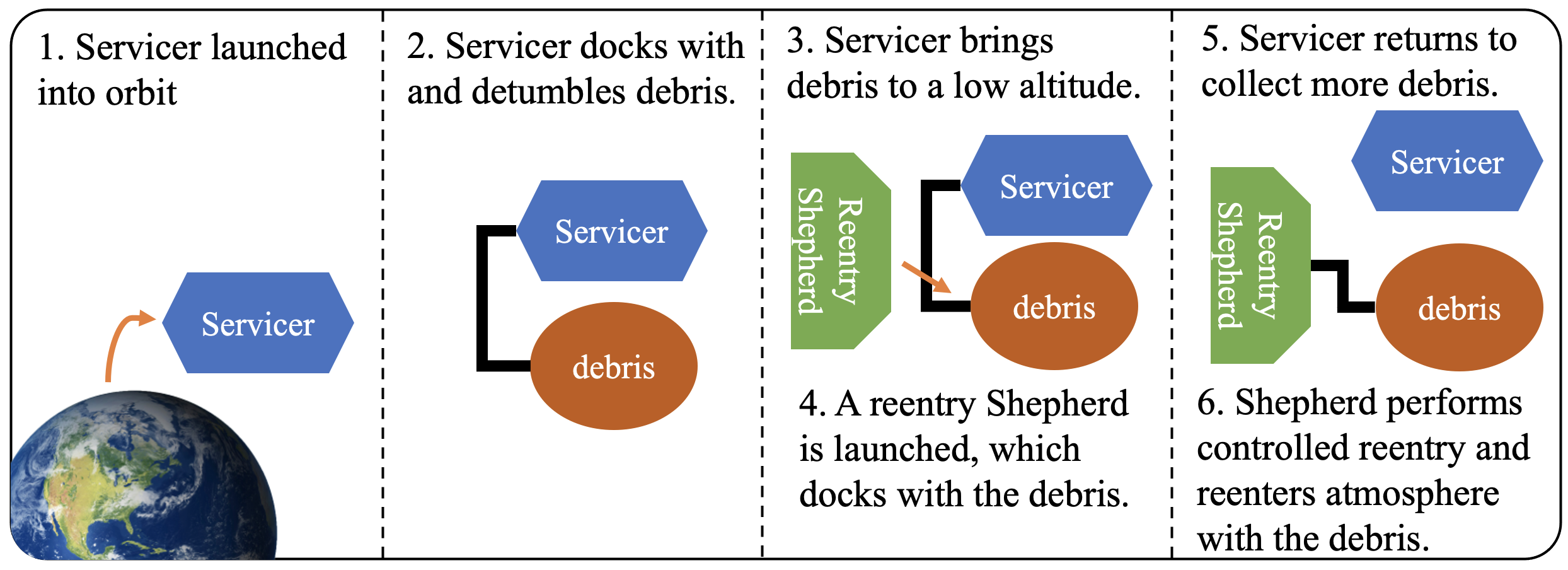
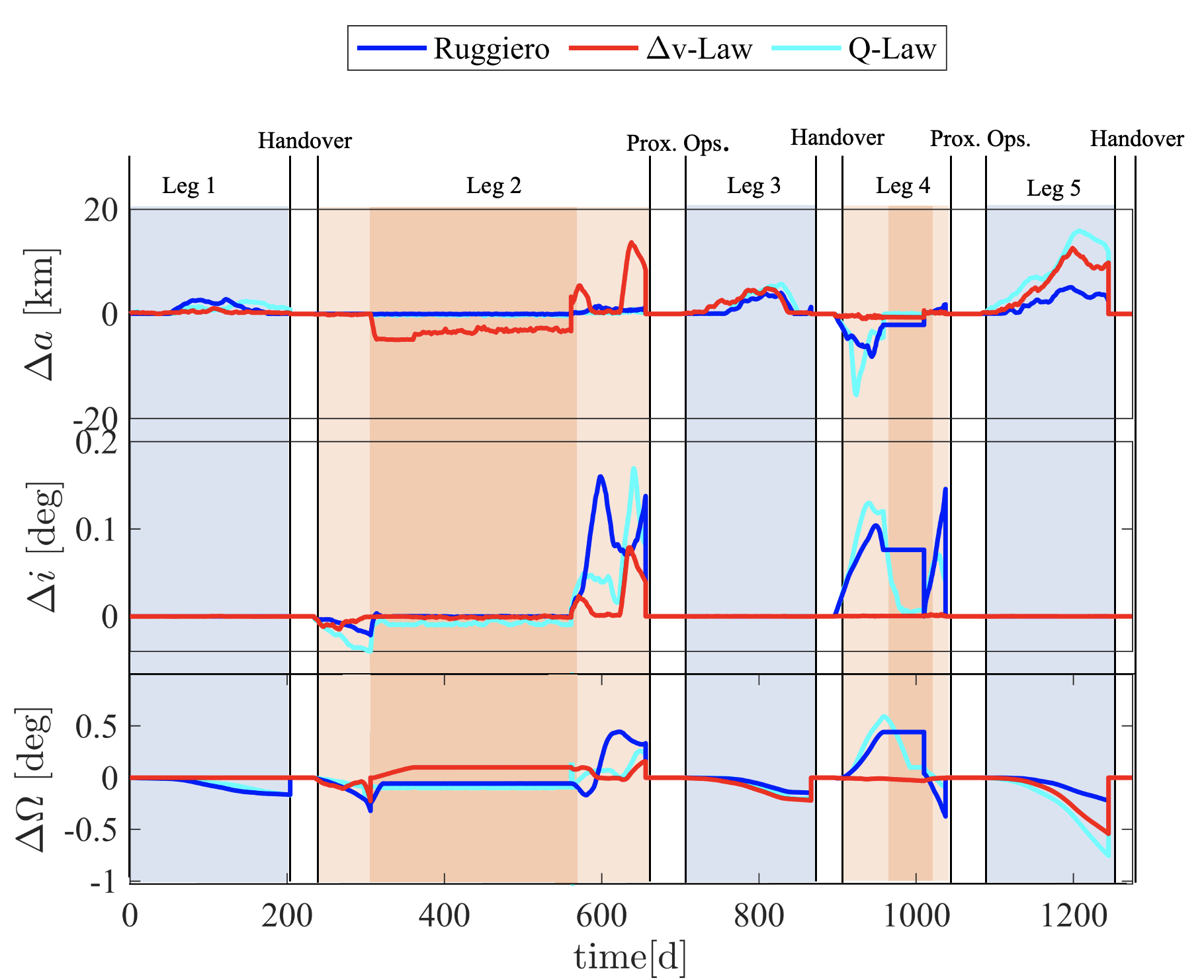
In the paper’s case study, the mission uses two spacecraft (Servicer + Shepherd) to remove multiple tonne-class objects from sun-synchronous LEO, with a hybrid of low-thrust transfer arcs and chemical deorbiting for re-entry compliance.
Method
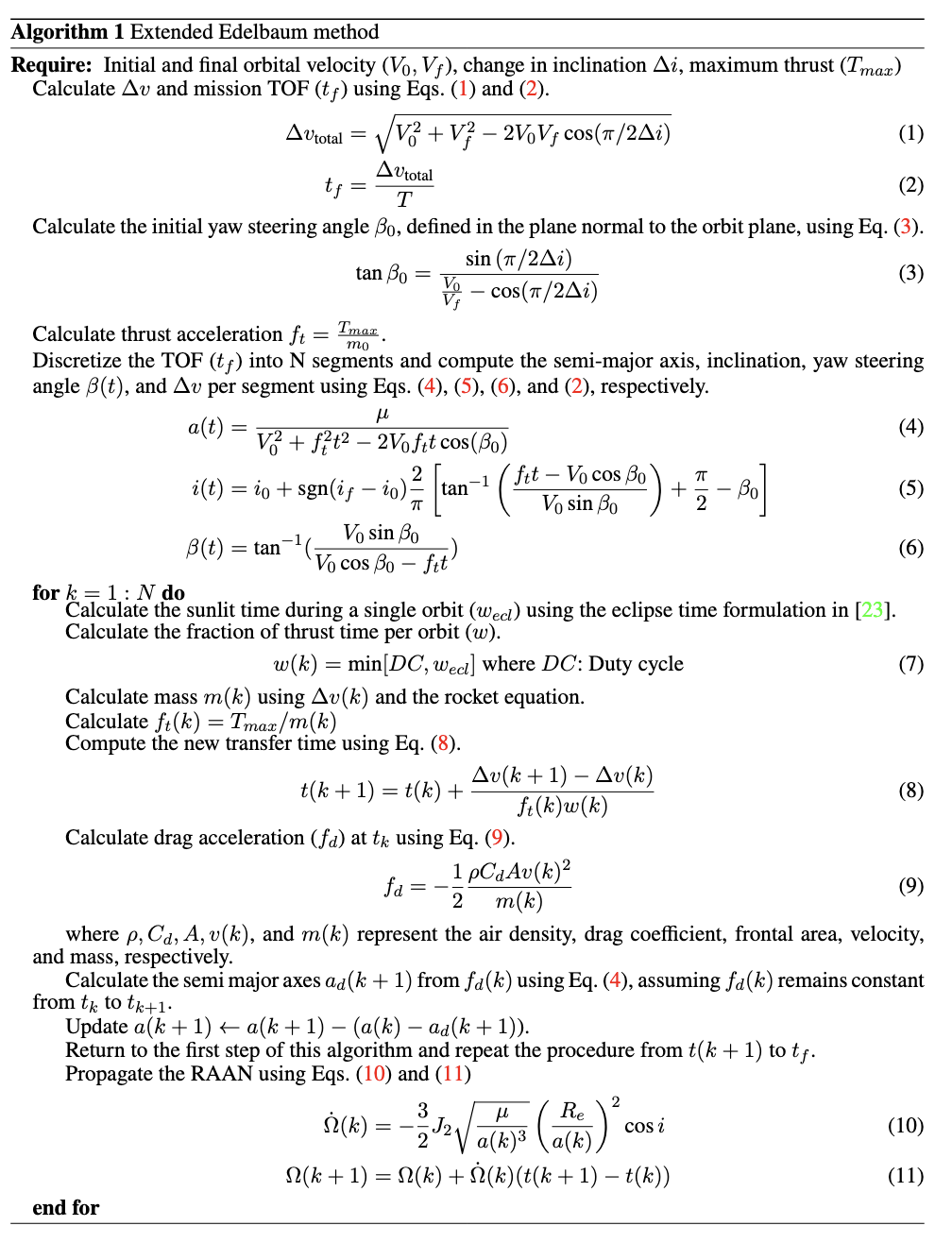
1) Extended Edelbaum transfers (drag + eclipses + duty cycle)
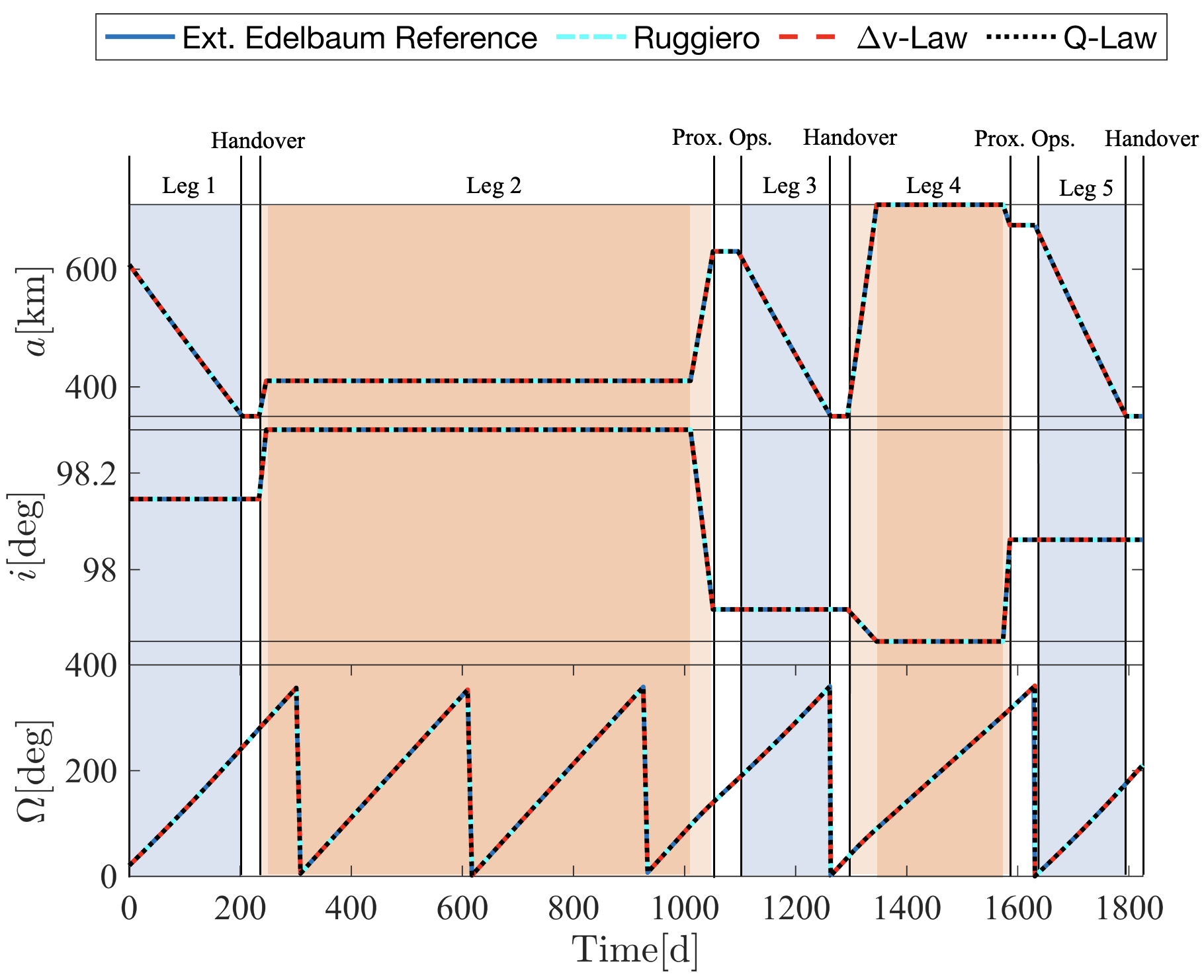
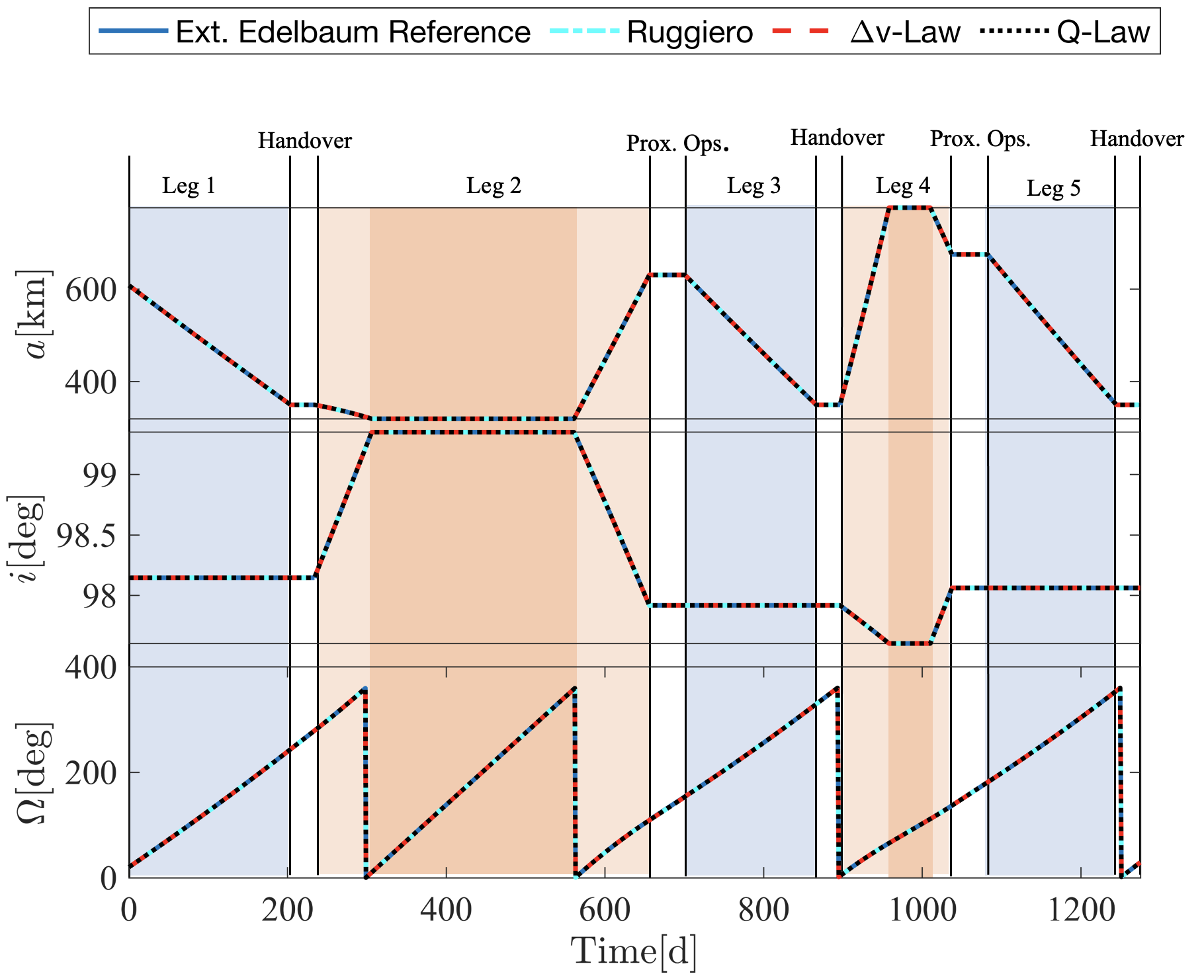
PMDT builds on an extended Edelbaum method to compute low-thrust transfers in \((a,i)\) while accounting for drag (semi-major axis decay), eclipse-limited thrust availability, and duty-cycle throttling. Conceptually, the transfer is discretised into nodes and updated with additional accelerations and availability weights.
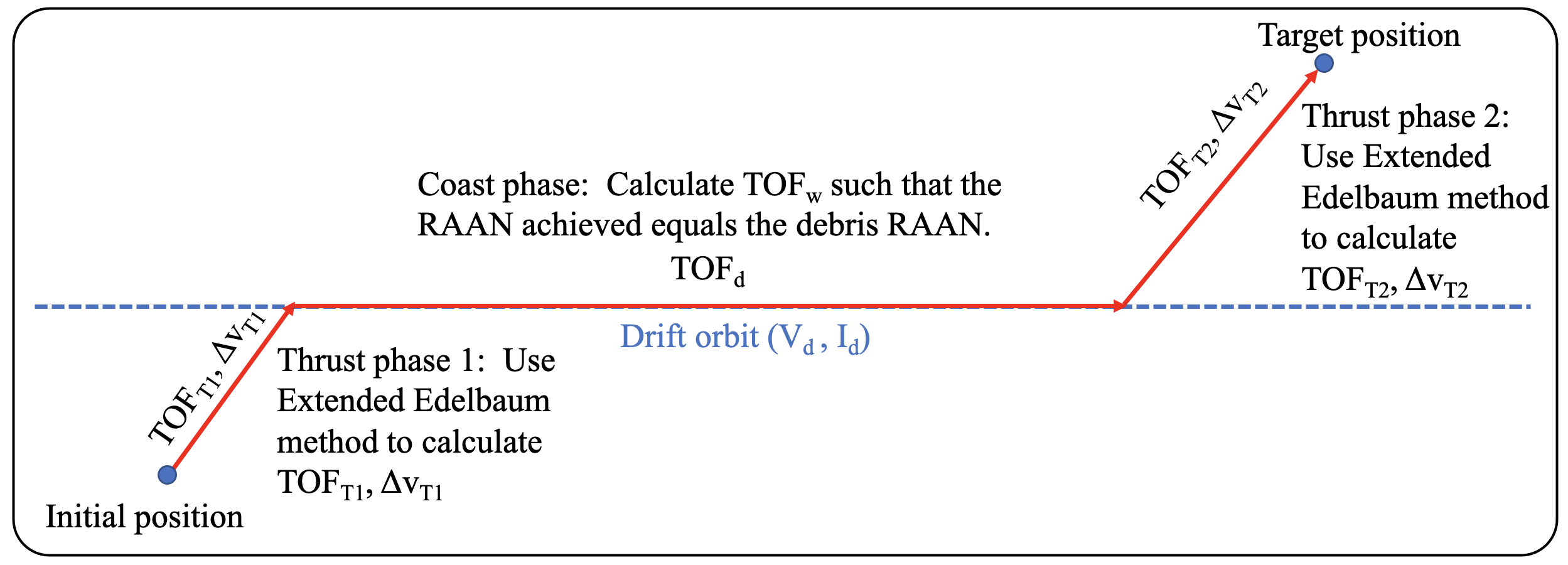
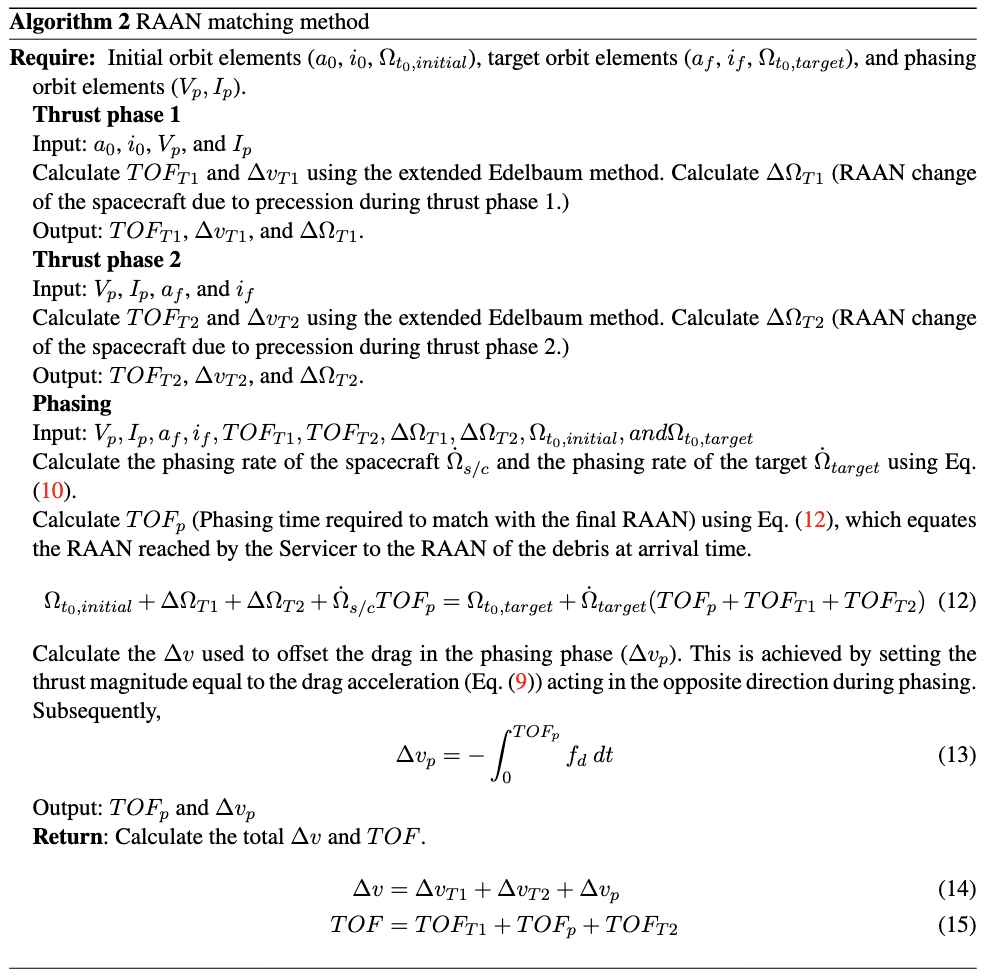
2) RAAN matching via thrust–phasing–thrust (using \(J_2\) precession)
To match a target RAAN efficiently, PMDT inserts an intermediate phasing orbit that leverages differential \(J_2\) precession. The sequence is: thrust to a phasing orbit, coast (with optional drag-compensation thrust), then thrust to the target orbit.
3) Multi-target tour accounting (handover + proximity operations)
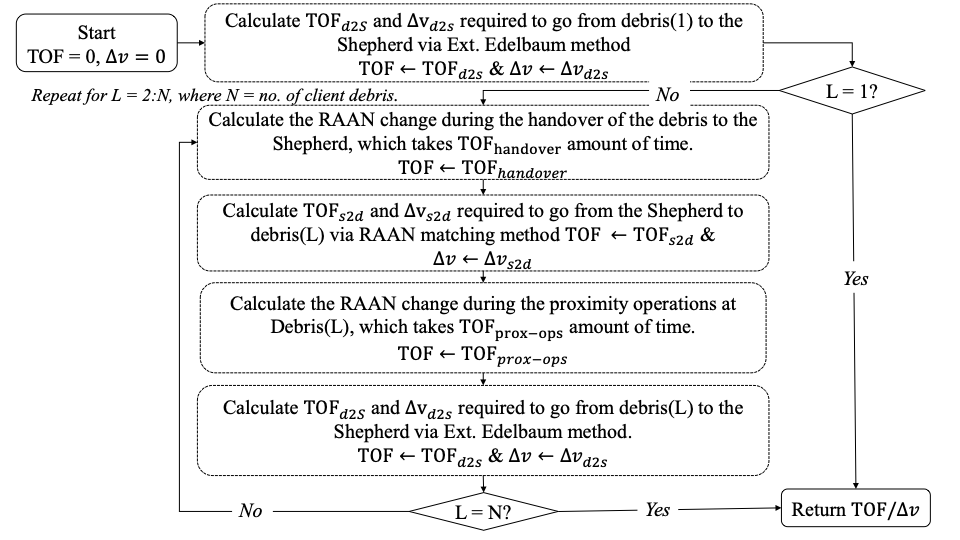
For a candidate tour \(\{\text{debris}(1),\dots,\text{debris}(N)\}\), PMDT sums transfer costs leg-by-leg and includes non-transfer phases such as handover time and proximity operations time. The Shepherd orbit and the Servicer’s rendezvous/return pattern are explicitly represented in the tour evaluation.
Results
Resources
If you use PMDT to screen tour candidates, consider keeping PMDT’s model fidelity aligned with the downstream optimiser (e.g., perturbation set, eclipse model, and duty cycle) to avoid ranking artefacts.
Cite this work
BibTeX
@article{Wijayatunga2023PMDT,
  title   = {Design and guidance of a multi-active debris removal mission},
  author  = {Wijayatunga, Minduli C. and Armellin, Roberto and Holt, Hugh and Pirovano, Laura and Lidtke, Ashley A.},
  journal = {Astrodynamics},
  year    = {2023},
  doi     = {10.1007/s42064-023-0159-3}
}